

When Should You Replace a Sink Drain? Common Warning Signs
There’s a point where a sink stops having “small issues” and starts quietly telling you something’s wearing out. Most people miss that point. Not because they don’t care.
by Sooraj T. Mathews
Jun 04, 2026
4 minute read
Table of Contents
- There’s a point where a sink starts showing signs
- It usually starts with repetition
- Then the drain gets slower (and it sneaks up on you)
- Smell is usually a deeper problem
- Visible damage is the obvious one (but also the late one)
- Leaks that come and go
- And then there’s water coming back up
- Why this all happens (it’s rarely just one thing)
- Repair vs replacement (the part people delay)
- Choosing a replacement isn’t as complicated as it sounds
- The part most people realize too late
There’s a point where a sink starts showing signs
There’s a point where a sink stops having “small issues” and starts quietly telling you something’s wearing out.
Most people miss that point.
Not because they don’t care. It’s just… nothing dramatic happens. No loud failure. No sudden break. Just a slow shift in how things behave.
And honestly, that’s what makes it easy to ignore.
A clog that shows up again sooner than expected. Water that lingers a bit longer before disappearing. A smell that comes back even after you’ve cleaned everything properly.
Individually? Nothing urgent.
Together? That’s a pattern. And patterns like that usually don’t fix themselves.
It usually starts with repetition
A clog once in a while—fine. That’s normal.
You clear it. Move on.
Second time? Still not a big deal. Happens in every house.
But then it becomes familiar. You already know what tool to grab. You don’t even think about it much—you just deal with it again.
That’s where things shift.
Because now it’s not about something getting stuck. It’s about something staying there. Buildup. Rough surfaces inside the drain. Old residue that never fully clears out.
Water still flows, sure. But not cleanly. Not smoothly.
You fix it… and then you fix it again.
And again.
That cycle is usually the first real sign the drain isn’t what it used to be.
Then the drain gets slower (and it sneaks up on you)
This one’s subtle. Almost annoyingly subtle.
The sink doesn’t stop working. There’s no moment where you go, “Okay, this is broken.”
Instead, it just feels slightly off.
You might not notice it right away. Then one day you do. And after that, you can’t unsee it.
Water takes longer to go down. Not by much. Just enough to make you pause for a second.
That’s usually internal narrowing. Minerals from hard water, soap buildup, all the usual stuff. It collects over time and slowly reduces the space inside the pipe.
Not enough to block it. Just enough to slow it.
And here’s the thing—once it reaches that stage, cleaning only helps temporarily. The surface inside is already compromised.
Smell is usually a deeper problem
If your sink smells and you clean it—and the smell disappears—that’s normal.
But if it comes back?
That’s different.
That means whatever’s causing it isn’t sitting near the surface. It’s deeper. Somewhere inside the drain where regular cleaning doesn’t reach.
Old debris. Bacteria. Trapped residue.
You can pour solutions down, scrub what you can see, even flush it with hot water. It might improve for a bit. But then the smell shows up again.
A properly functioning drain doesn’t hold onto odors like that.
When it does, something’s changed internally. And not in a way that cleaning alone can fix.
Visible damage is the obvious one (but also the late one)
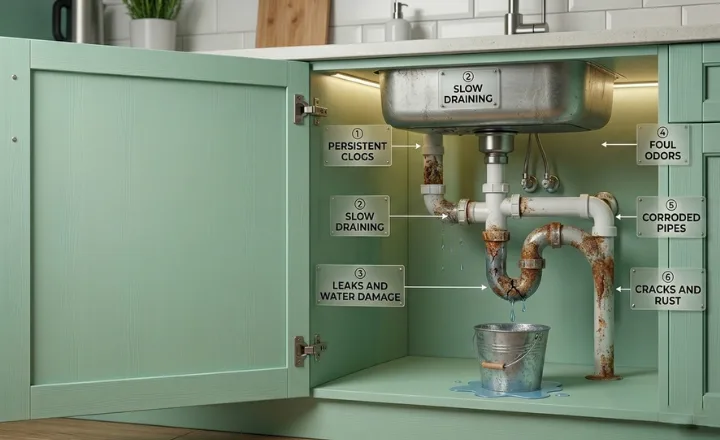
Rust. Hairline cracks. Corrosion around the drain body.
If you can see it, you’re already past the early stage.
Metal doesn’t fail overnight. It wears down slowly. Moisture, chemicals, temperature changes—it all adds up.
By the time rust is visible, the material has already weakened.
Same with cracks. They don’t just appear out of nowhere. They’ve been forming gradually.
You can tighten fittings. You can try sealing small areas.
But none of that reverses the actual damage.
At best, it buys time.
Leaks that come and go
A one-time leak? Usually not a big deal.
Something loosened. You tighten it. Done.
But when the same area leaks again later—even slightly—that’s not just a loose connection anymore.
That points to wear.
Maybe the seal isn’t holding the way it used to. Maybe the material has expanded and contracted too many times. Maybe there’s a tiny crack you can’t fully see yet.
The frustrating part is that these leaks often disappear after you fix them… which makes it easy to ignore when they come back.
But recurring leaks rarely stay minor forever.
And then there’s water coming back up
This is where it starts feeling less “minor.”
If water backs up once, you might shrug it off. Could be a temporary blockage.
But if it happens again—even after you’ve cleared the drain—that’s different.
That usually means one of two things:
- Either there’s a deeper restriction you’re not reaching
- Or the drain itself isn’t handling flow properly anymore
Both point to something beyond a simple fix.
And this is usually the stage where people realize the problem isn’t just surface-level anymore.
Why this all happens (it’s rarely just one thing)
It’s not like one single issue suddenly breaks the drain.
It’s gradual. Layered.
- Minerals from hard water slowly coating the inside
- Soap and grease building up over time
- Small installation imperfections that didn’t matter at first
- Constant exposure to moisture wearing down materials
- General aging—nothing fancy, just time doing its thing
None of these feel urgent on their own.
But together, they change how the drain behaves.
And eventually, the system just… doesn’t perform the way it used to.
Repair vs replacement (the part people delay)
Most people try to fix things as long as possible.
That’s normal. Makes sense.
If it’s a one-off issue—a clog, a loose connection—repairing it is the right move.
But when the same problems keep coming back, you’re not really fixing anything anymore.
You’re just resetting the clock.
That’s the part people don’t always notice.
If you’ve cleaned the drain multiple times and the issue returns…
If you’ve tightened connections but leaks reappear…
If smells keep coming back no matter what you do…
At that point, it’s not maintenance anymore.
It’s wear.
And worn parts don’t recover. They just continue declining.
Choosing a replacement isn’t as complicated as it sounds
A lot of people overthink this part.
You don’t really need to.
Material matters, sure:
- PVC is simple and affordable
- Stainless steel handles moisture well
- Brass tends to last longer and resists corrosion better
But honestly, fit matters more than anything.
If the replacement doesn’t match your sink setup properly, you’ll run into issues again—no matter how good the material is.
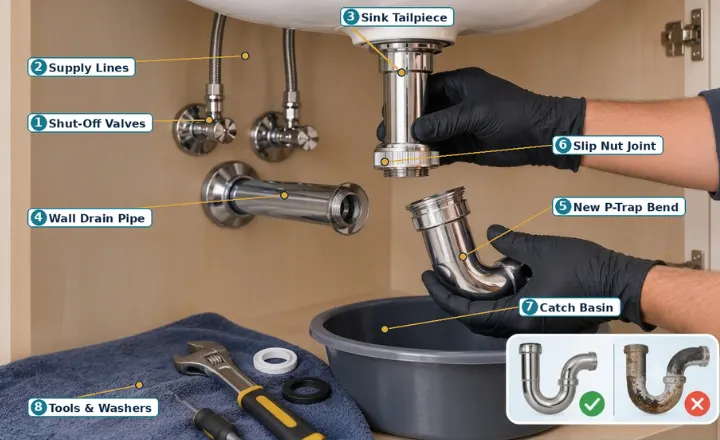
Installation depends on your setup. Some are straightforward. Some take a bit more effort.
But the decision itself?
Not as complicated as people expect.
The part most people realize too late
Drain problems rarely feel urgent.
That’s why people wait.
Because each issue on its own seems manageable.
A clog here. A smell there. A small leak. Nothing major.
But when those issues start overlapping—or showing up more often—that’s usually the turning point.
At that stage, the drain isn’t just dirty.
It’s worn out.
And that’s the difference.
One can be cleaned.
The other needs to be replaced.
If you want the truth, most people don’t replace their drain at the right time. They wait until it becomes unavoidable.
Not because they didn’t see the signs.
But because the signs didn’t feel serious—until they all showed up at once.
```
-min (1).png)
Sooraj T. Mathews
Sooraj is a content creator with 6 years of experience and a knack for making SEO work feel like storytelling. With 4 years in the digital marketing game, he blends strategy and creativity to craft content that clicks and converts. Outside of work, you'll find him unwinding with a good puzzle or getting lost in a great book—always curious, always learning.
.webp)
.webp)
.webp)
.webp)